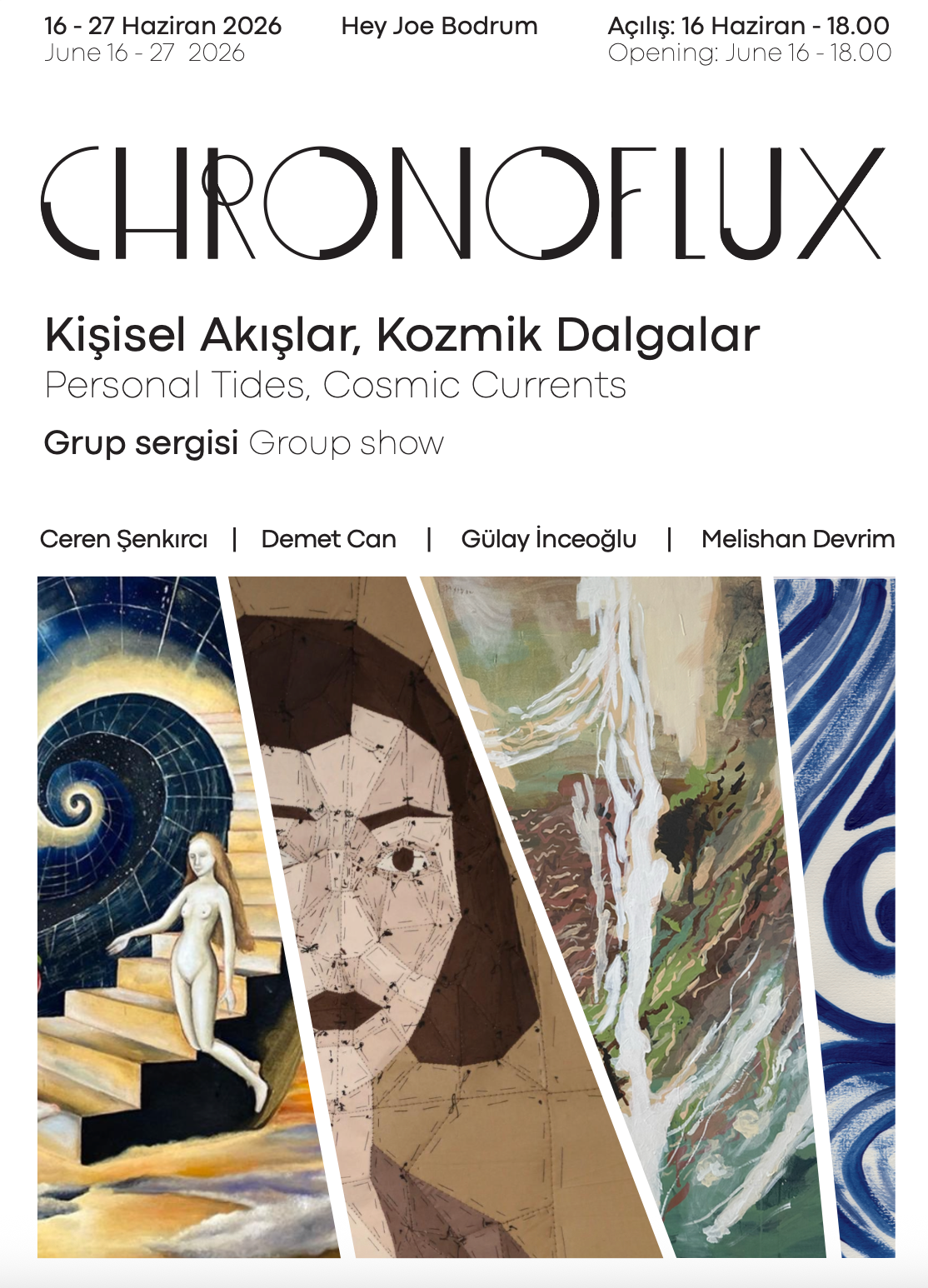
"Chronoflux: Kişisel Akışlar, Kozmik Dalgalar" Chronoflux, Yunanca zaman (chronos) ve Latince akış (flux) kelimelerinin birleşiminden oluşan yeni bir sözcük.
16-27 Haziran 2026 tarihleri arasında Hey Joe Bodrum'un galeri alanında devam eden "Chronoflux: Kişisel Akışlar, Kozmik Dalgalar" grup sergisi, zamanın akışının kozmosla bağlantısını düşünmeyi öneriyor. Sergide Ceren Şenkırcı, Demet Can, Gülay İnceoğlu ve Melishan Devrim'in zamanın akışını ve kozmosla bağlantısını yorumladıkları eserler yer alıyor. 21. yüzyılda yapay zeka araçları ile Endüstri Devrimi'nin dördüncü aşamasını yaşadığımız bugünlerde, uzaya ve zamana dair anlayışımız gelişmeye devam ediyor; kuantum hesaplama alanındaki gelişmeler sayesinde artık kuantum bilgisayarlardan söz ediliyor. Bu gelişmeler sanata da yansıyor. Geçtiğimiz yüzyılda, Einstein'ın Görelilik Kuramı'nda zamana yaptığı dair tanım, 20. yüzyıl sanatçılarını çok etkilemişti. Modern çağın sanatçıları, doğanın durmak bilmeyen değişimini ve dinamizmini tuvale aktarmak istediklerinde dışavurumculuktan yararlandılar.
Fütüristler ve kübistler, tuval üzerine zaman boyutunu nasıl sunabileceklerini araştırırken, eşzamanlılık kavramını aynı formun üst üste binen görüntüleri olarak sunmayı denediler. İtalyan fütürist heykeltraş Umberto Boccioni, bugün başyapıtı kabul edilen "Uzayda Sürekliliğin Eşsiz Biçimleri" (Unique Forms of Continuity in Space) (1913) adlı heykelinde, üç boyutlu formda zamanın etkisini görselleştirmek için klasik geometrinin kurallarını bozup, objenin farklı planlarını üst üste bindirerek hız duygusunu heykelde sunmayı başardı. Freud'un teorilerinden ve rüya analizlerinden etkilenen Sürrealistlerin de ilham kaynağı oldu zamanın akışı. Dali'nin "Belleğin Kalıcılığı" (The Persistence of Memory) (1931) resminde, saatlerin Camembert peyniri gibi eriyen hali, Einstein'ın Görelilik Kuramı'nda zamanın sabit ve tekil olmak yerine akışkan olmasına gönderme yapan en ünlü eserlerden biri. Kuantum fiziği, sicim teorisi (string theory) veya yüksek boyutlu uzay zaman geometrilerinde, bilinen üç boyutlu uzay ve dördüncü boyut olarak zaman boyutuna eklenen beşinci bir serbestlik derecesinin veya alanın bulunduğu varsayılıyor. Bağımsız teorik fizikçi Roy David Herbert ise "chronoflux" terimini zamanı akışkan bir dinamik olarak beşinci boyutta tanımladığı teorik fizik prensibini tanımlamak üzere 2025'te tartışmaya açtı. Zamanı akışkan beşinci boyut şeklinde düşünme önerisi, Einstein'ın Görelilik Kuramı'nda zamanı ilk kez, üç boyutlu evrendeki dördüncü boyut olarak tanımlamasını anımsatıyor.
Zaman kavramı, Gülay İnceoğlu'nun dışavurumcu tuvallerde objenin formunun bozulmasıyla renklerin ritm kazanması olarak karşımıza çıkıyor. Kaos, düzen, bütüne aitlik ve organik bir çözülme anı tuval üzerindeki renklerin dinamizmiyle melodik kompozisyonlara dönüşüyor. Demet Can, kendi ürettiği teknikle yaptığı portrelerinde geleneksel ile modernin kesiştiği anı araştırıyor. Portrelerini, önce keskin geometrilerde hazırladığı kumaş parçalarını el dikişiyle kolaj şeklinde birleştirip ardından tuvale monte ederek üretiyor. Açıkça görünen dikişler yaşanmışlığın, zamanın izlerinin kanıtlarına dönüşüyor. Melishan Devrim, dijital ve kağıt üzerine çizimlerinde mikrokozmos ile makrokozmos arasındaki benzerlikleri araştırıyor; kuantum teorilerindeki nedensel dinamik üçgenleme fikrine odaklanarak, ışığın dalga boylarının kırmızıya veya maviye kaymasını, kurallı geometrik kompozisyonlarla aktarıyor. Ceren Şenkırcı, mitlerden yola çıkarak günümüzün gerçekliğini yorumladığı iki tuvalinde ilk yaratılış anı ile robotlara dair bir sorgulama üretiyor. İnsanımsı robotların hayatımıza eklenecek olmasını kozmik bir kuluçka evresi olarak tanımlıyor ve bunun Adem ve Havva'nın yaratılışı ile kontrastını vurguluyor. Mitoloji, insanın yaptığı bir seçimin, yani tek bir andaki bir kararın, herkesin kaderini nasıl etkileyebileceğini anlatan örneklerle dolu. Adem ve Havva anlatısında, iki insanın kaderi tek bir kararla değişiyor: Cennetten kovulduklarında zaman artık insanlar için ölüme doğru ilerleyen bir gerisayım haline geliyor. Şenkırcı'nın resmindeki Adem ve Havva ise henüz kozmosun merkezindeler ve yaklaşan sibernetik gelecekten habersizler.
Zaman, ok gibi tek yöne hareket eden, sabit bir kavram mı? Yoksa verdiğimiz kararlarla akışını seçtiğimiz, aynı anda birden fazla yöne sürekli akan, dinamik bir alan mı? Tek yöne akan bir zaman kavramı yerine duruma bağlı, göreli zamanlar olduğunu savunan kuantum teorilerine kültürel perspektiften bakınca kadim hikayelerde bu düşüncenin izlerine rastlama ihtimalimiz beliriyor. Kozmostaki zaman kavramı ile insanın yaşam süresi arasında niceliksel olarak devasa bir fark var. Mevcut bilimsel bilgimiz açısından, içinde yaşadığımız Samanyolu'nun, yaklaşık 4 ila 6 milyar yıl içinde Andromeda ile çarpışması bekleniyor; bu olayın galaksinin yapısını ve boyutunu dramatik biçimde değiştireceği öngörülüyor. Güneş'in ise 5 milyar yıl içinde Kızıl Dev aşamasına girerek Dünya'yı yaşanamaz hale getireceği, hatta yok edeceği öngörülüyor.
Biyolojik olarak zamanın yönü bizim için sadece ölüme doğru ilerliyor. Ölüm kavramı yalnızca canlı organizmalar için değil, belirli kozmolojik süreçler bağlamında galaksiler için de mecazi anlamda söz konusu. Yıldız üretmeyi bırakmış, ışığını yavaş yavaş yitirmiş galaksilere bu yüzden “kırmızı ve ölü” adı veriliyor. Evren genişledikçe entropi artıyor; galaksiler, yıldızlar ve gezegenler de bu büyük akış içinde yavaş yavaş sönmeye, dağılmaya ve yok oluşa yaklaşıyor. Ancak bu, doğrudan fiziksel “yok oluş” anlamında değil, aslında bir dönüşüm. İnsan yaşamı da bu büyük kozmik zaman ölçeği içinde kısacık, kozmik bir döngüye benziyor.
-
"Chronoflux: Personal Tides, Cosmic Currents" Chronoflux is a new word formed by combining the Greek word for time (chronos) and the Latin word for flow (flux).
The group exhibition "Chronoflux: Personal Flows, Cosmic Waves," running at Hey Joe Bodrum's gallery space from June 16 to June 27, 2026, invites reflection on the connection between the flow of time and the cosmos. The exhibition features works by Ceren Şenkırcı, Demet Can, Gülay İnceoğlu, and Melishan Devrim that interpret the flow of time and its connection to the cosmos. In the 21st century, as we experience the fourth phase of the Industrial Revolution with artificial intelligence tools, our understanding of space and time continues to evolve; thanks to advances in quantum computing, quantum computers are now being discussed. These developments are also reflected in art. A century ago, Einstein’s definition of time in the Theory of Relativity greatly influenced 20th century artists. When modern era artists wanted to convey nature’s incessant change and dynamism onto canvas, they drew on expressionism. Modern artists relied mainly on expressionism to capture nature's dynamic, constantly evolving character in painting.
Futurists and cubists, while exploring how to present the dimension of time on canvas, attempted to depict simultaneity as overlapping images of the same form. Italian futurist sculptor Umberto Boccioni, in his masterpiece "Unique Forms of Continuity in Space" (1913), succeeded in conveying a sense of speed in sculpture by breaking the rules of classical geometry and superimposing different planes of the object to visualize the effect of time in three-dimensional form. The flow of time also inspired the Surrealists, influenced by Freud’s theories and dream analysis. In Dali's painting "The Persistence of Memory" (1931), the melting clocks resembling Camembert cheese are one of the most famous works referencing Einstein's Theory of Relativity, where time is fluid rather than fixed and singular. In quantum physics, string theory, and higher-dimensional spacetime geometries, it is hypothesized that a fifth degree of freedom or field exists in addition to the familiar three spatial dimensions and time as the fourth dimension. Independent theoretical physicist Roy David Herbert introduced the term "chronoflux" for debate in 2025 to describe a theoretical-physics principle that defines time as a fluid dynamic in a fifth dimension. The proposal to think of time as a fluid fifth dimension echoes Einstein’s first definition of time in the Theory of Relativity as the fourth dimension in a three-dimensional universe.
The concept of time in Gülay İnceoğlu’s expressionist canvases appears through the distortion of form and the rhythmic interplay of color. Chaos, order, a sense of belonging, and moments of organic dissolution are transformed into melodic compositions by the colors’ dynamism on the canvas. Demet Can investigates the moment where tradition and modernity intersect in her self-developed portrait technique. She creates portraits by hand-stitching fabric pieces cut into sharp geometric shapes into collages, then mounting them on canvas. The visible seams become evidence of lived experience and traces of time. Melishan Devrim explores the similarities between the microcosm and the macrocosm in her digital and paper drawings; focusing on the idea of causal dynamic triangulation in quantum theories, she depicts shifts of light wavelengths toward red or blue using orderly geometric compositions. In two canvases that reinterpret the present through myths, Ceren Şenkırcı creates an inquiry linking the first moment of creation with robots. She describes the addition of humanoid robots to our lives as a cosmic incubation phase and emphasizes its contrast with the creation of Adam and Eve. Mythology is full of examples showing how a choice made by one person, a decision in a single moment can affect everyone's fate. In the Adam and Eve story, the destiny of two people changes with one choice: when they are expelled from Paradise, time becomes a countdown toward death for humans. In Şenkırcı’s painting, however, Adam and Eve are still at the center of the cosmos and unaware of the approaching cybernetic future.
Is time a fixed concept that moves in a single direction like an arrow? Or is it a dynamic field that flows continuously in multiple directions at once, whose course we choose with our decisions? If we view quantum theories that argue for situation-dependent, relative times instead of a unidirectional concept of time from a cultural perspective, we may find traces of this idea in ancient stories. There is a quantitatively enormous difference between the concept of time in the cosmos and a human lifespan. According to current scientific knowledge, our Milky Way is expected to collide with Andromeda in roughly 4 to 6 billion years; this event is predicted to dramatically change the galaxy’s structure and scale. The Sun is expected to enter its Red Giant phase in about 5 billion years, rendering Earth uninhabitable and eventually destroying it.
Biologically, time's direction for us moves only toward death. The concept of death applies metaphorically not only to living organisms but also to galaxies in certain cosmological contexts. Galaxies that have stopped forming stars and are gradually losing their light are therefore called "red and dead." As the universe expands, entropy increases; galaxies, stars, and planets slowly fade, disperse, and approach extinction within this great flow. But this is not extinction in a strictly physical sense: it is actually a transformation. Human life is also exceedingly brief on this vast cosmic timescale, resembling a tiny cosmic cycle.